

Overview
Article 275(1) of the Indian Constitution empowers the Parliament of India to provide grants-in-aid from the Consolidated Fund of India to such states as it may determine. These grants are specifically meant to promote the welfare of Scheduled Tribes (STs) and improve the administration of Scheduled Areas.
This provision serves as a critical constitutional mechanism to address historical injustices and support inclusive development by enabling targeted financial assistance for tribal welfare programs and infrastructure in tribal regions.
Constitutional Foundation
Article 275(1) of the Indian Constitution enshrines the Union Government's mandate to provide grants-in-aid to the revenues of States. This provision empowers Parliament to determine which States require assistance and to fix varying sums based on their unique needs.
Critically, the proviso to Article 275(1) specifically directs the payment of both capital and recurring sums from the Consolidated Fund of India. These funds are essential to enable States to meet the costs of development schemes undertaken with the approval of the Government of India. The primary aims of these schemes are twofold:
- Promoting the welfare of the Scheduled Tribes within the respective State.
- Raising the level of administration of the Scheduled Areas therein to bring it on par with the administration in other areas of that State.
Core Objectives
Promote Socio-Economic Development: To uplift the Scheduled Tribes through targeted initiatives in education, health, livelihood, and infrastructure.
Strengthen Administration in Scheduled Areas: To improve governance, service delivery, and accessibility in tribal regions designated as Scheduled Areas.
Bridge Developmental Gaps: To reduce disparities between tribal and non-tribal areas through focused and need-based financial assistance.
Preserve Tribal Culture and Heritage: To support programs that protect and promote the rich cultural traditions, languages, and identity of tribal communities.
Ensure Participatory Development: To encourage community-led planning and implementation of welfare schemes, ensuring relevance and sustainability.
Support Capacity Building: To build institutional and human resource capacity in tribal regions, empowering local institutions like Gram Sabhas and Tribal Advisory Councils.
Key Features of the Scheme
The design of the Article 275(1) Grants incorporates several distinguishing features:
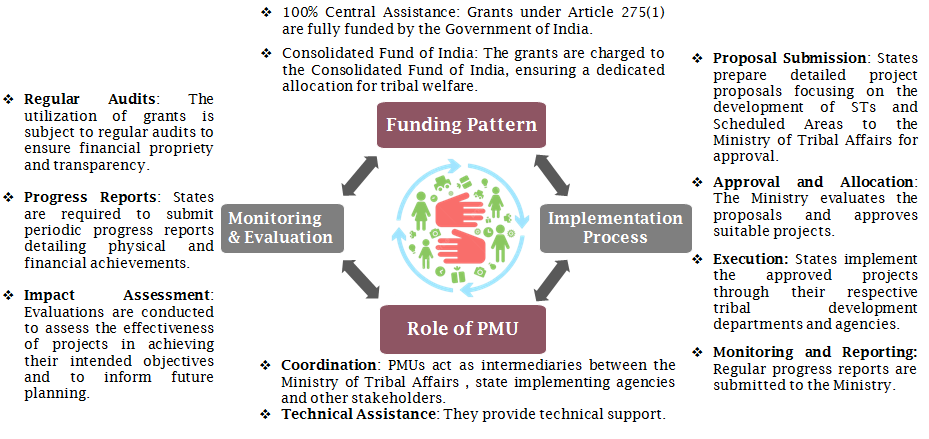
- Fully Funded: The scheme is entirely funded by the Government of India, underscoring its unwavering commitment to tribal development.
- Annual Disbursement: Funds are released as annual grants to States, based on approved project proposals, guaranteeing consistent and predictable financial support.
- Inclusive & Sustainable Development: A core emphasis is placed on fostering development that is not only inclusive of all tribal segments but also environmentally sustainable.
- Targeted Focus: The scheme prioritizes development in remote and historically backward tribal areas to proactively reduce regional disparities.
Eligibility Criteria
State Eligibility: All states with Scheduled Tribes and Scheduled Areas can receive grants under Article 275(1). The allocation is based on the proportion of the ST population and the area's specific needs.
Project Eligibility: States must propose development projects aimed at improving the socio-economic conditions of STs and the administration of Scheduled Areas. These projects should align with the objectives outlined in the guidelines provided by the Ministry of Tribal Affairs.
Benefits
Socio-Economic Development: The grants facilitate the implementation of projects that enhance education, healthcare, infrastructure, and livelihood opportunities for ST communities.
Administrative Enhancement: Funds are utilized to strengthen administrative structures in Scheduled Areas, ensuring better governance and service delivery.
Supplementary Support: These grants act as an additive to state plan funds, bolstering state efforts in tribal development.